
Dakota County Arrest Records vs Criminal Court Records
An arrest record is created when a person is taken into custody. The Dakota County Sheriff publishes only current custody on the jail roster, with limited fields. A criminal court record is created after charging and continues through the District Court case. Arrest records and criminal court records are separate files held by separate offices. Both are public in part, but each carries its own privacy classification under Minnesota law.
Most users want one of three things: confirmation that a person is in jail right now, the criminal court history tied to a charge, or a formal background check for an employer or housing decision. Each of those uses a different tool. The jail roster handles the first. MCRO Case Search handles the second. The BCA Public Criminal History Search handles the third, and BCA links its results through fingerprints, which is why the Minnesota Judicial Branch directs background-check users to BCA rather than MCRO.
How to Search Dakota County Arrest and Criminal Records
Three official portals are involved. The county jail roster covers current custody at the Law Enforcement Center. The BCA public criminal history search covers confirmed criminal-history records. MCRO covers criminal court cases filed in Dakota County District Court. Each portal is free.
- For current arrest custody, open the Dakota County Jail Inmate Search and enter a last name and any other criterion.
- For confirmed criminal-history records, open the Minnesota BCA Public Criminal History Search and enter last name, first name, middle name, and date of birth (all required).
- For the underlying criminal court case in Dakota County, open MCRO Case Search, narrow to Dakota, and review the Register of Actions.
- For active warrants, use the Dakota County warrant search.
- For prison custody or post-release supervision, use the Minnesota DOC offender locator.
- For federal custody, use the federal Bureau of Prisons inmate locator.
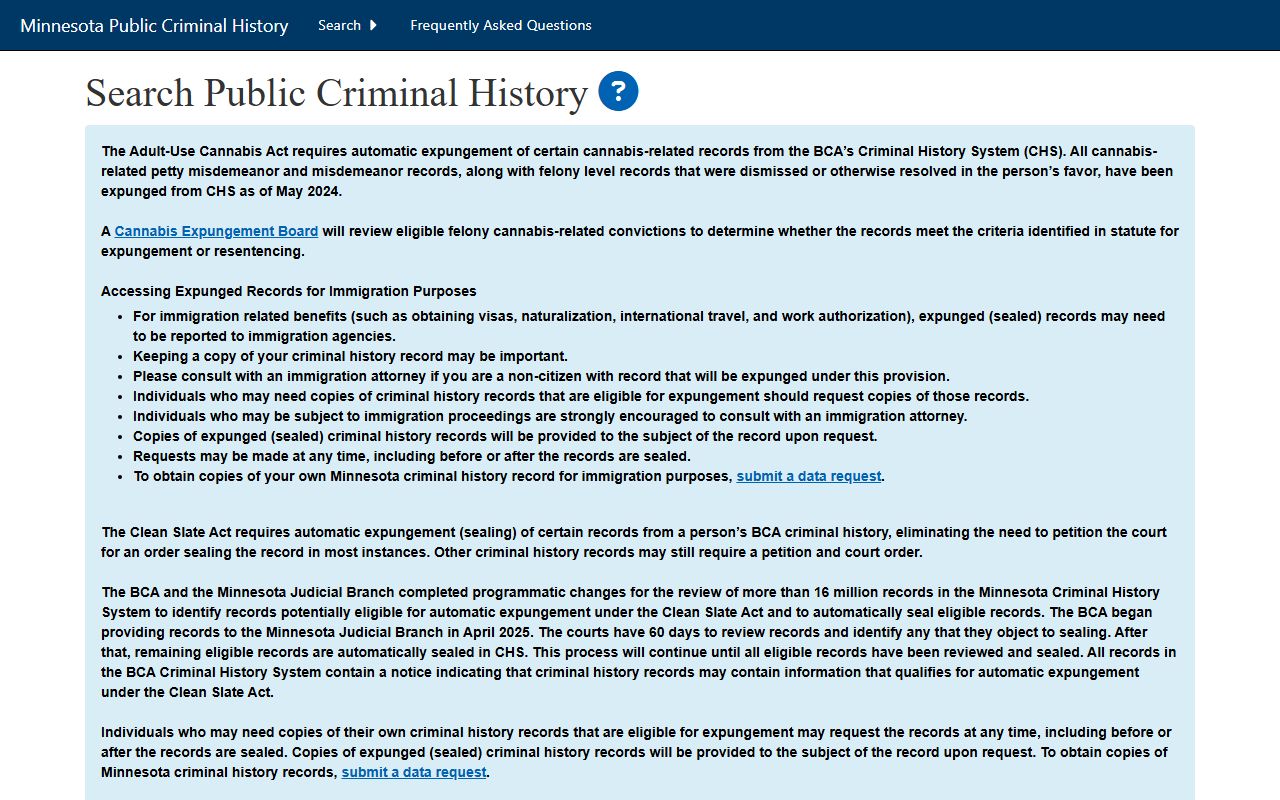
The BCA Public Criminal History Search form requires all four identifier fields and produces fingerprint-linked criminal-history results. It is the right tool for Minnesota background checks, including Dakota County records.
Dakota County Background Check Through BCA
The Minnesota Department of Public Safety / BCA explains the public background check workflow on its BCA public background-check page. Public criminal history through BCA is fingerprint-based, not name-based. For a Dakota County employer, landlord, or volunteer-screening use, the BCA search is the recognized tool. The BCA portal also cites Minn. Stat. 13.87, subd. 3(f), which warns users about obligations when using the information for employment, housing, or credit decisions.
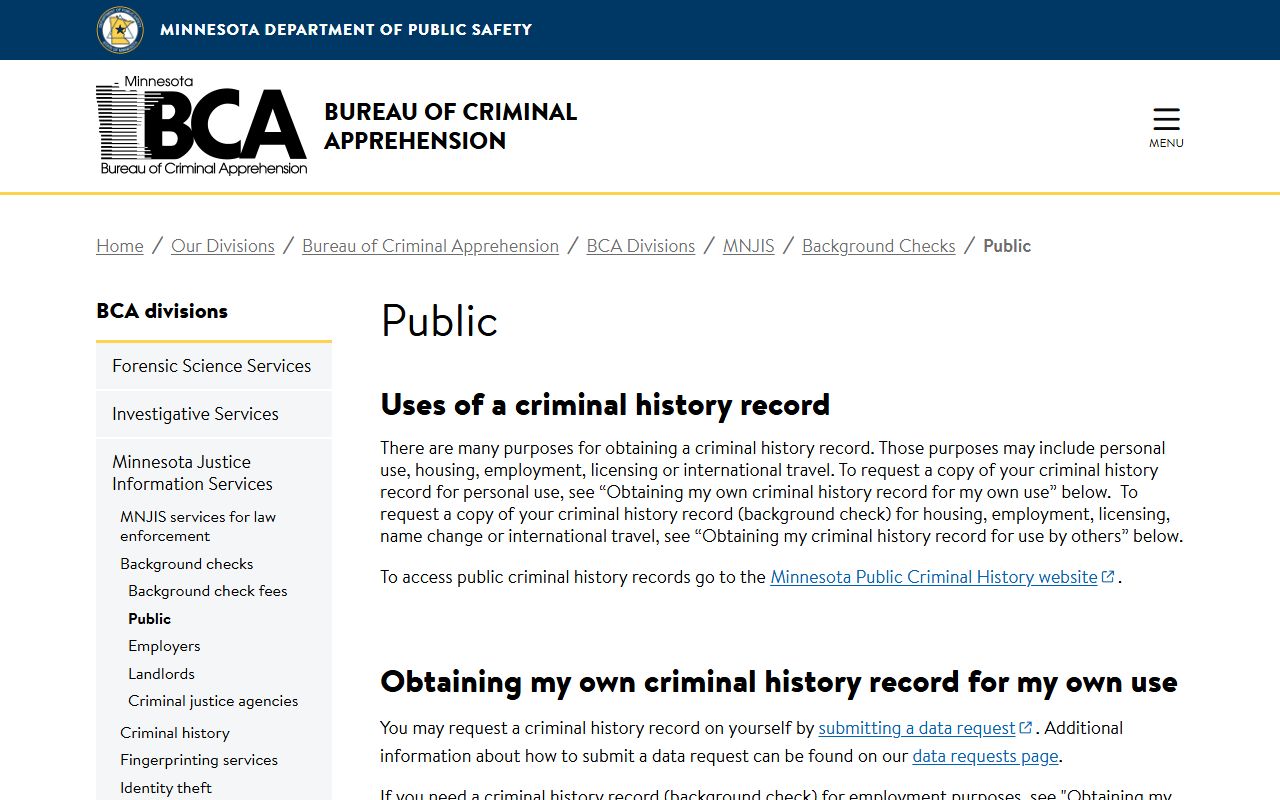
The BCA background-checks page links the public criminal history portal and the related statutes. Read both before relying on the result for any decision that affects the subject of the report.
What Dakota County Arrest and Criminal Records Show
An arrest record from the Dakota County jail roster shows current custody only. Public fields generally include the inmate name, date posted, court date, and limited custody information. The county warns that information should not be relied on for legal action and that identity can only be confirmed through fingerprint comparison. A criminal court record in MCRO shows the case caption, charge level, statute citation, plea, sentence, restitution, probation, and the Register of Actions. A BCA criminal history record shows fingerprint-linked criminal history maintained by the state.
A comparison table can help readers pick the right tool for a Dakota County criminal-records lookup.
| Record Source | What It Shows | Best Use |
|---|---|---|
| Dakota County Jail Roster | Current custody only; name, date posted, court date. | Confirm a person is in custody right now. |
| MCRO Case Search | Criminal court case, Register of Actions, hearings, public documents. | Review a charged case in Dakota County District Court. |
| BCA Public Criminal History | Fingerprint-linked criminal history maintained by the state. | Employment, housing, volunteer screening background checks. |
| Minnesota DOC Locator | People committed to the Commissioner of Corrections. | Track prison custody and post-release supervision. |
| BOP Inmate Locator | Federal Bureau of Prisons custody. | Federal custody after federal conviction. |
Charges vs Convictions in Dakota County
A criminal charge is the formal accusation. A conviction is the finding or plea of guilt. The two are not the same. MCRO warns that case type is not the final outcome and that a felony case type may end in a misdemeanor sentence. Dakota County criminal cases include felony, gross misdemeanor, misdemeanor, and petty misdemeanor categories. Pending cases without a conviction will not return in MCRO name searches, although they may still appear in a case-number search.
| Charge | Conviction | |
|---|---|---|
| What it is | Formal accusation by complaint or indictment. | Finding or plea of guilt entered by the court. |
| Effect on rights | Limited; presumption of innocence remains. | Permanent record absent expungement or pardon. |
| MCRO visibility | Pending name searches restricted; case-number returns work. | Visible on MCRO once disposition is entered. |
| BCA visibility | Arrests may appear; charges without conviction handled per statute. | Appears in BCA fingerprint-linked criminal history. |
Sealed vs Expunged Dakota County Records
Sealing and expungement are related but distinct. Sealing usually refers to a court order restricting access to a specific record. Expungement under Chapter 609A seals court records from public access without destroying them. Minnesota's expungement framework includes petition-based and automatic paths. Petition expungements require service on affected agencies, a hearing no sooner than 60 days after service, and victim-notice rules.
| Sealed | Expunged | |
|---|---|---|
| Source | Court order restricting access. | Statutory process under Chapter 609A. |
| Record destroyed? | No. | No; sealed from public access only. |
| Law enforcement access | Allowed for legitimate purposes. | Allowed for certain statutory purposes. |
| Public access | Restricted. | Restricted. |
| Background checks | Usually hidden. | Usually hidden. |
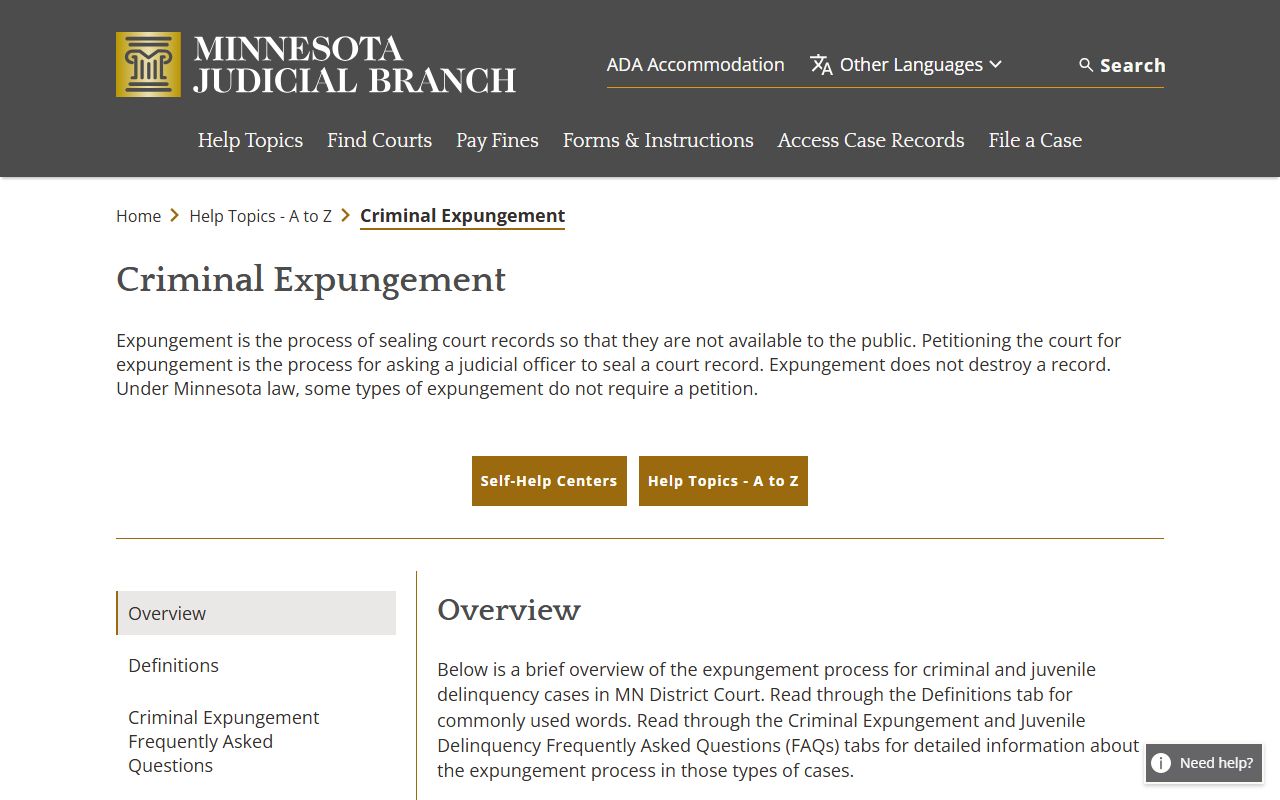
The Minnesota Judicial Branch expungement help topic at mncourts.gov/help-topics/criminal-expungement walks through eligibility, forms, and the petition workflow.
Dakota County Expungement Process
Most expungement petitions in Dakota County are filed in District Court with notice to the prosecuting agency, the law enforcement agency that handled the arrest, and the Minnesota BCA. A petition under section 609A.03 must include the petitioner's legal names and aliases, date of birth, addresses from the offense date to the petition date, the reason for the expungement, the offense and arrest details, the court file number, the date of conviction or dismissal, rehabilitation information for convictions, the complete criminal conviction and charge history, prior expungement or pardon requests, and any relevant protective or no-contact orders. A hearing is held no sooner than 60 days after service, and victims may submit statements.
Some expungements do not require a petition. Prosecutor-agreement paths, cannabis expungement, and Clean Slate-related provisions are part of Chapter 609A. Automatic expungements have rolled out under recent law changes; the BCA criminal history portal notes Clean Slate Act review beginning in 2025. The Minnesota Judicial Branch help page lists forms, eligibility criteria, and a fee-waiver path for filers who cannot pay the filing fee.
Mugshots, Booking Photos, and the Blotter
The Dakota County jail page does not publish a public mugshot gallery. Booking data is classified as law-enforcement data under Minn. Stat. 13.82. Some booking information is public, while active investigative material and protected victim and witness data are not. For a request that goes beyond the public jail-roster page, contact the Sheriff's Office at 651-438-4700 with the specific information requested and the statutory basis. No official Dakota County mugshot removal process is published; if the image is part of a public record, expungement or sealing may affect access.
Dakota County Attorney and the County Charging Decision
Most criminal cases in Dakota County are prosecuted by the Dakota County Attorney's Office. The Dakota County Attorney is Kathryn M. Keena, the 24th Dakota County Attorney and the first woman to serve in the role. The office can be reached at 651-438-4438 or attorney@co.dakota.mn.us. City attorneys prosecute many misdemeanor and petty misdemeanor cases that begin in their jurisdictions. The County Attorney's official page covers duties and current leadership.
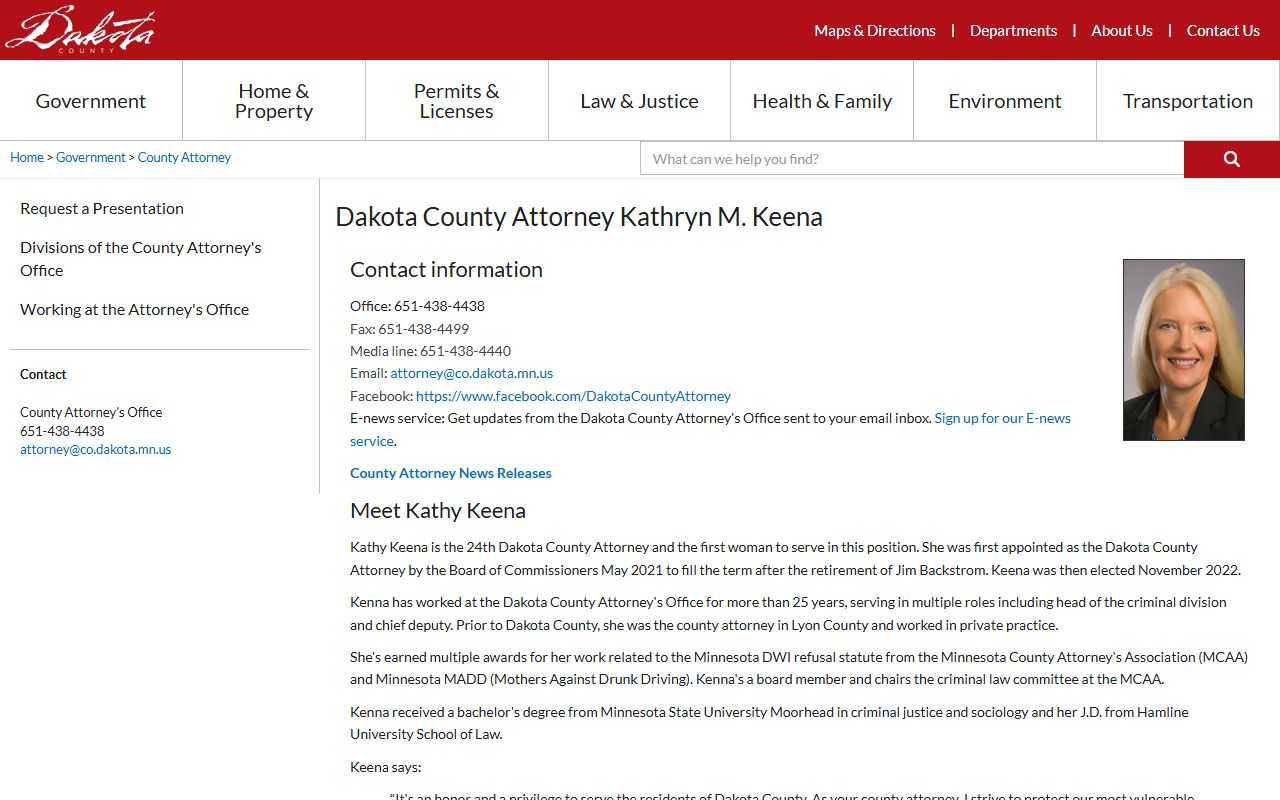
The County Attorney page is the right contact for prosecution questions tied to a Dakota County criminal case. Victims and witnesses can also use the County Attorney's victim/witness support resources.
Restricted Criminal Records in Dakota County
Several categories sit outside the standard public criminal search in Dakota County. Juvenile delinquency and CHIPS records are limited under Minn. Stat. 260B.171 and the Rules of Public Access. Predatory offender registry data is largely not public; DPS/BCA explains that the registry is not public except for non-compliant registrants and public-notification or risk-level cases. The community notification framework comes from Minn. Stat. 244.052. The Minnesota predatory offender registration statute is Minn. Stat. 243.166.
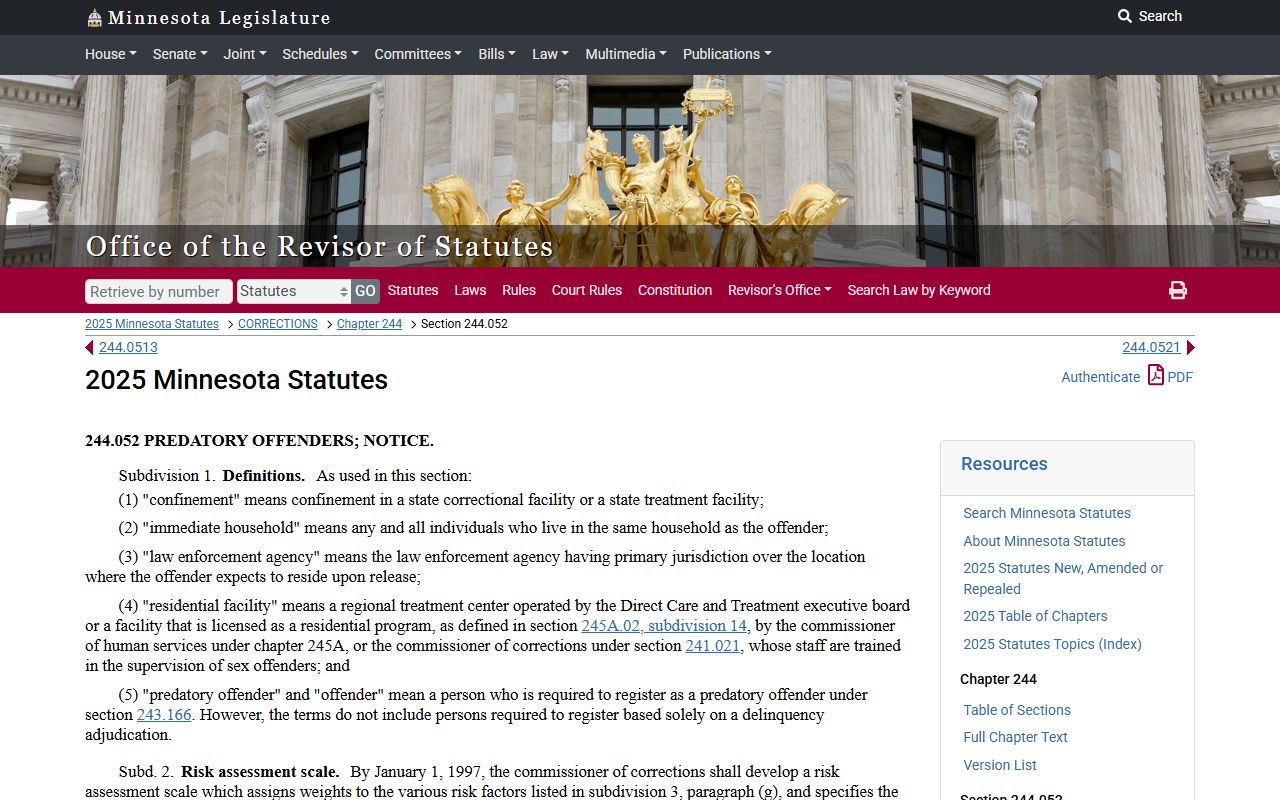
The community notification statute is the basis for public-notification and risk-level disclosures, and it is referenced by the DOC public registrant search.
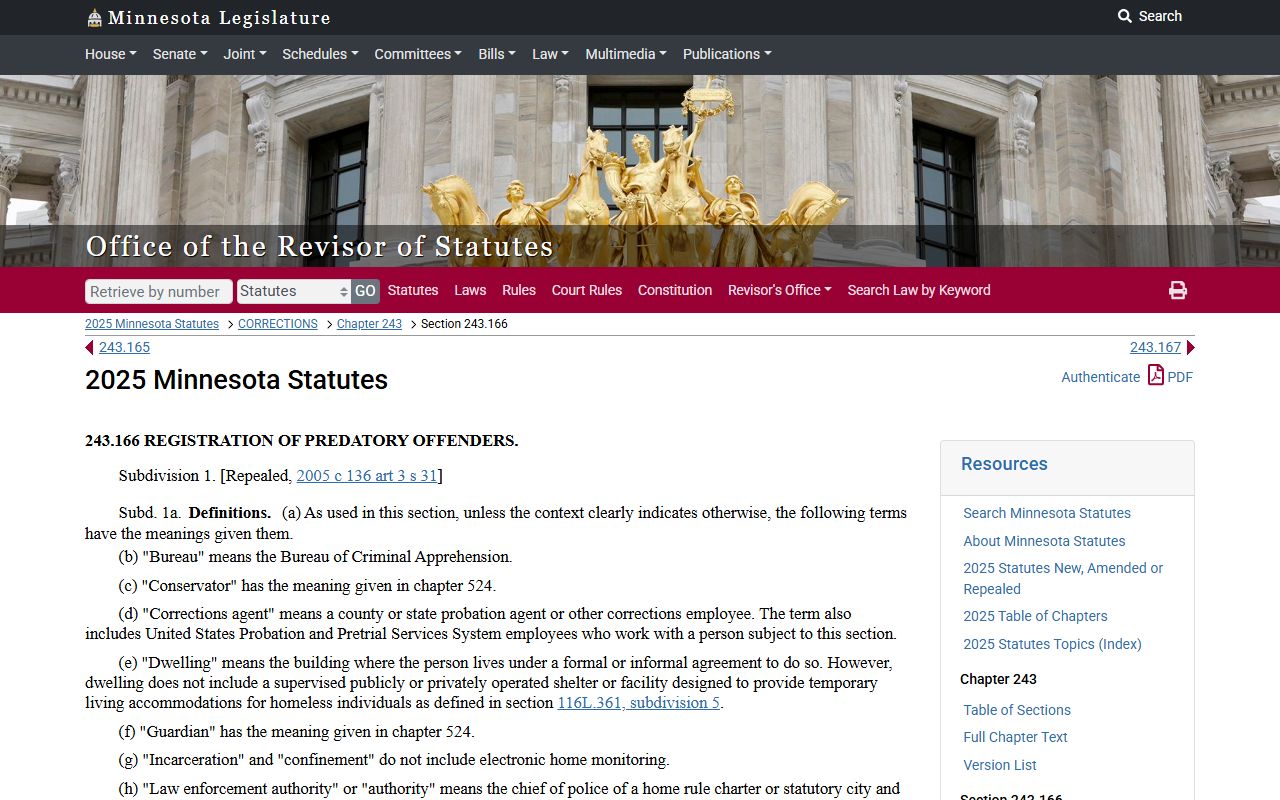
The predatory offender registration statute sets who must register, what information is collected, and which exceptions allow public disclosure.