
Dakota County Probate Division Contact
The Probate Division of Dakota County District Court is at the Judicial Center, 1560 Highway 55, Hastings, MN 55033. Phone is 651-377-7974 and fax is 651-437-2346. The division also handles mental health and adoptions. The Minnesota Judicial Branch lists Dakota County District Court as having original jurisdiction in civil, family, probate, juvenile, criminal, and traffic cases filed in the county, and the Probate Division is the right contact for any probate question or filing.
Probate Division
Dakota County District Court
Judicial Center, 1560 Highway 55
Hastings, MN 55033
651-377-7974
Fax 651-437-2346
Court Administration
Judicial Center
1560 Highway 55, Hastings, MN 55033
651-377-7180
Mon-Fri 8:00 a.m.-4:30 p.m.
Dakota County Probate Overview
The Minnesota Judicial Branch defines probate as the legal process of getting court authority to transfer property after death. To start a probate case, a petition or application is filed with the court and a personal representative is appointed by court order. The personal representative collects, inventories, and appraises assets; protects estate assets; pays debts; and distributes remaining assets to proper parties. The Judicial Branch help topic at mncourts.gov/help-topics/probate-wills-and-estates walks through the process at the state level, and Dakota County's Probate Division handles the case work for the county.
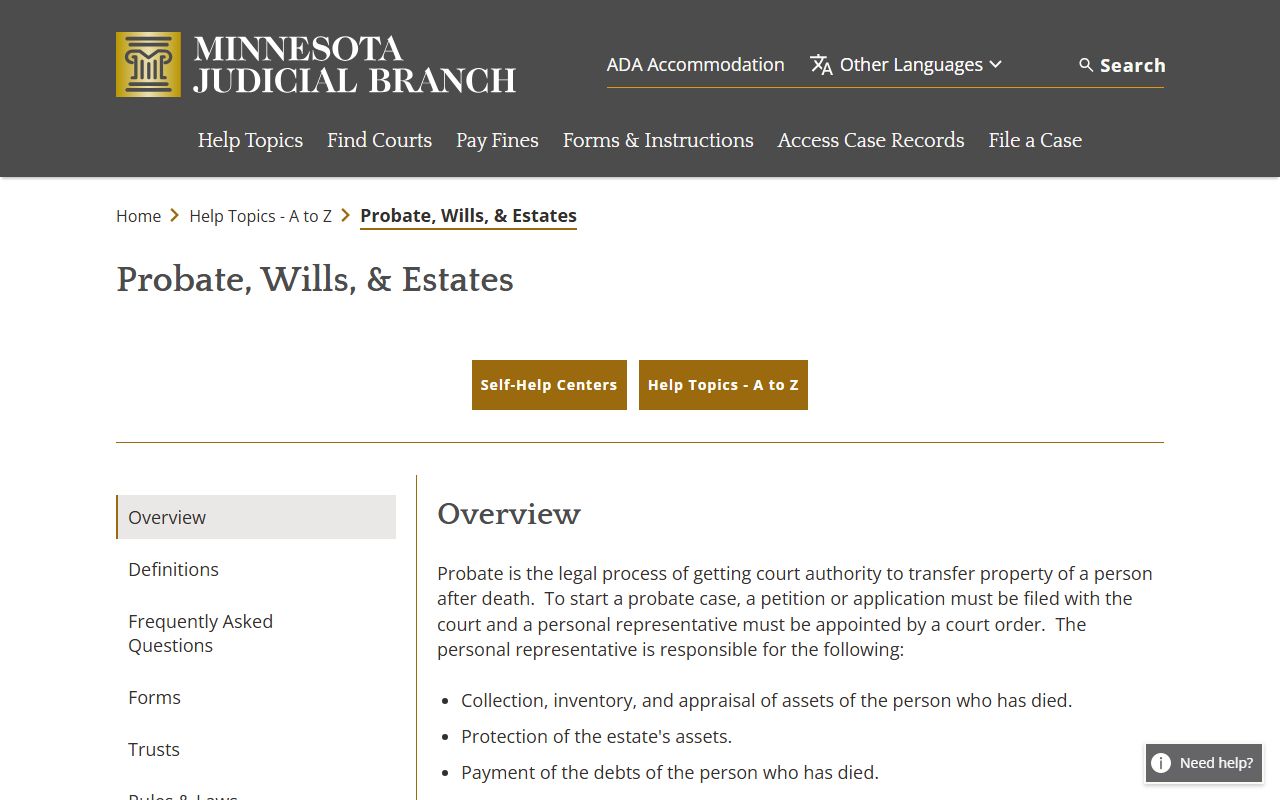
The Judicial Branch probate help page is the starting point for personal representatives, heirs, and creditors. Forms, definitions, and process descriptions are pulled together in one place.
Formal vs Informal Probate
Minnesota recognizes both formal and informal probate. Informal probate appoints a personal representative without a hearing before a judge in less complicated situations. Formal probate requests appointment through a hearing before a judge and is used when the situation is more complicated, when there is a will dispute, or when there is uncertainty about the validity of the will. A reader trying to decide which path to take should review the Judicial Branch help materials and contact the Probate Division for procedural guidance.
| Informal Probate | Formal Probate | |
|---|---|---|
| Hearing required? | No hearing before a judge | Hearing before a judge |
| When to use | Simpler estates, no disputes | Complicated estates, disputes, will questions |
| Personal representative | Appointed by Court Administrator | Appointed by court order after hearing |
| Filings | Application; standard forms | Petition; hearing notice; orders |
| Closing | Personal Representative's Statement to Close | Court order or accounting |
Dakota County Probate Forms
The Minnesota Judicial Branch publishes a probate forms library at mncourts.gov/getforms.aspx?c=31. The library covers small-estate affidavits, formal probate starting packets with and without a will, personal representative oaths, inventories, accountings, and closing statements. Each form is used in Dakota County District Court the same way it is used in any other Minnesota county.
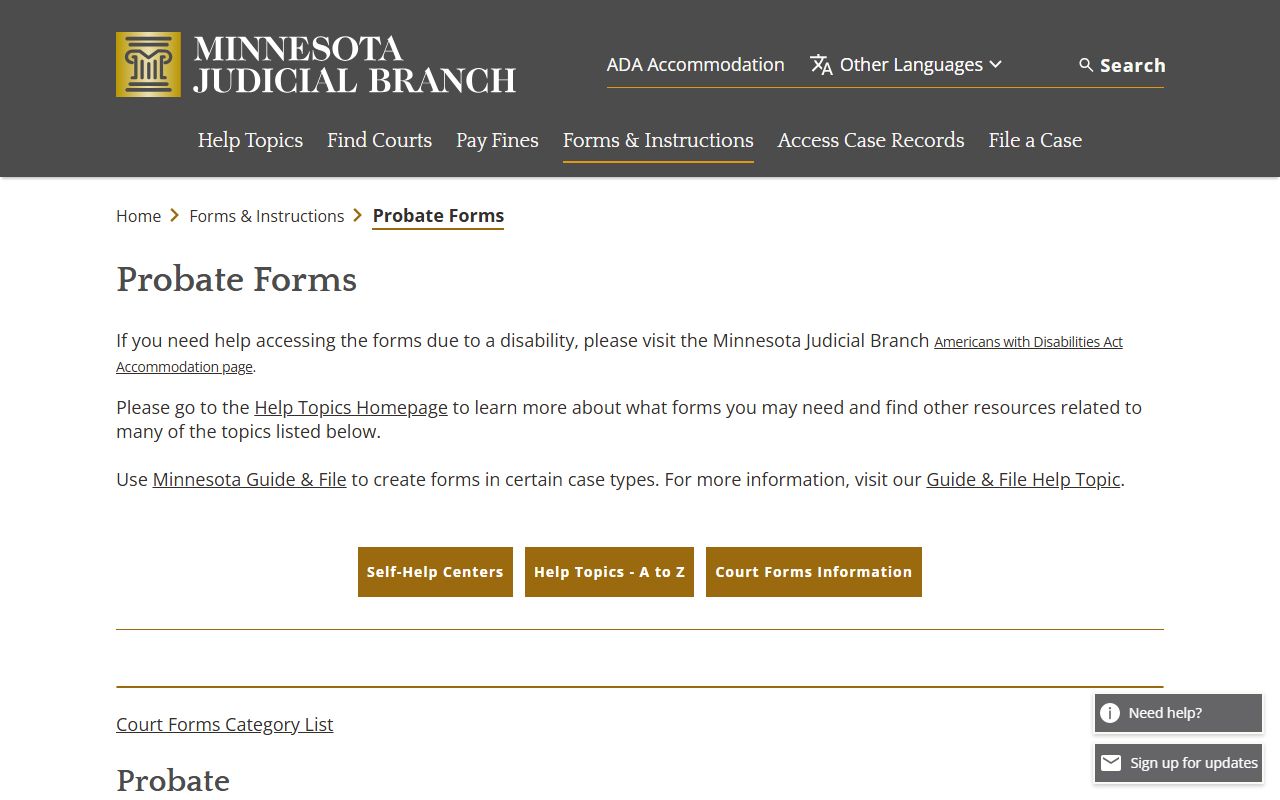
The probate forms library is the right resource for personal representatives and family members who are filing without a lawyer. Use the exact form names listed there in any submission.
- Affidavit for Collection of Personal Property (Small Estate - No Real Estate)
- Affidavit in Support of Search of Decedent's Safe Deposit Box
- Demand for Notice
- Objection (Probate)
- Written Statement of Claim
- Information about Probate in Minnesota (PRO101)
- Acceptance of Appointment of Personal Representative and Oath
- Inventory; Final Account and Proposal for Distribution
- Unsupervised Personal Representative's Statement to Close Estate
Searching Dakota County Probate Records Online
Public Dakota County probate records are searched through MCRO Case Search. Use the Case Search tab, enter a party or decedent name, narrow to Dakota County, and pick Probate or Mental Health as the case category. For a known case, the Document Search tab takes only the case number and returns public PDFs. MCRO provides online access to public documents in Formal Probate, Other Probate, Guardianship and Conservatorship, and Trust case types for documents filed on or after July 1, 2015. Older documents may need a contact to Court Administration.
| Field Label | Type | Required | Notes / Format |
|---|---|---|---|
| Case Search tab | Tab | Yes | Name, Case Number, Attorney. |
| Case Category | Checkbox | Optional | Probate or Mental Health. |
| Court Location | County list | Optional | Select Dakota. |
| Date Filed | Date | Optional | Narrow probate filing dates. |
| Document Search | Case-number text | Conditional | Enter case number to find online public documents. |
Small-Estate Affidavit in Dakota County
For smaller estates without real estate, Minnesota allows collection of personal property by affidavit under Minn. Stat. 524.3-1201. A small-estate affidavit is not the same as opening a full probate case. The Judicial Branch publishes the "Affidavit for Collection of Personal Property (Small Estate - No Real Estate)" form in the probate forms library. Banks, insurers, and other holders of estate property accept a properly completed affidavit in qualifying cases.
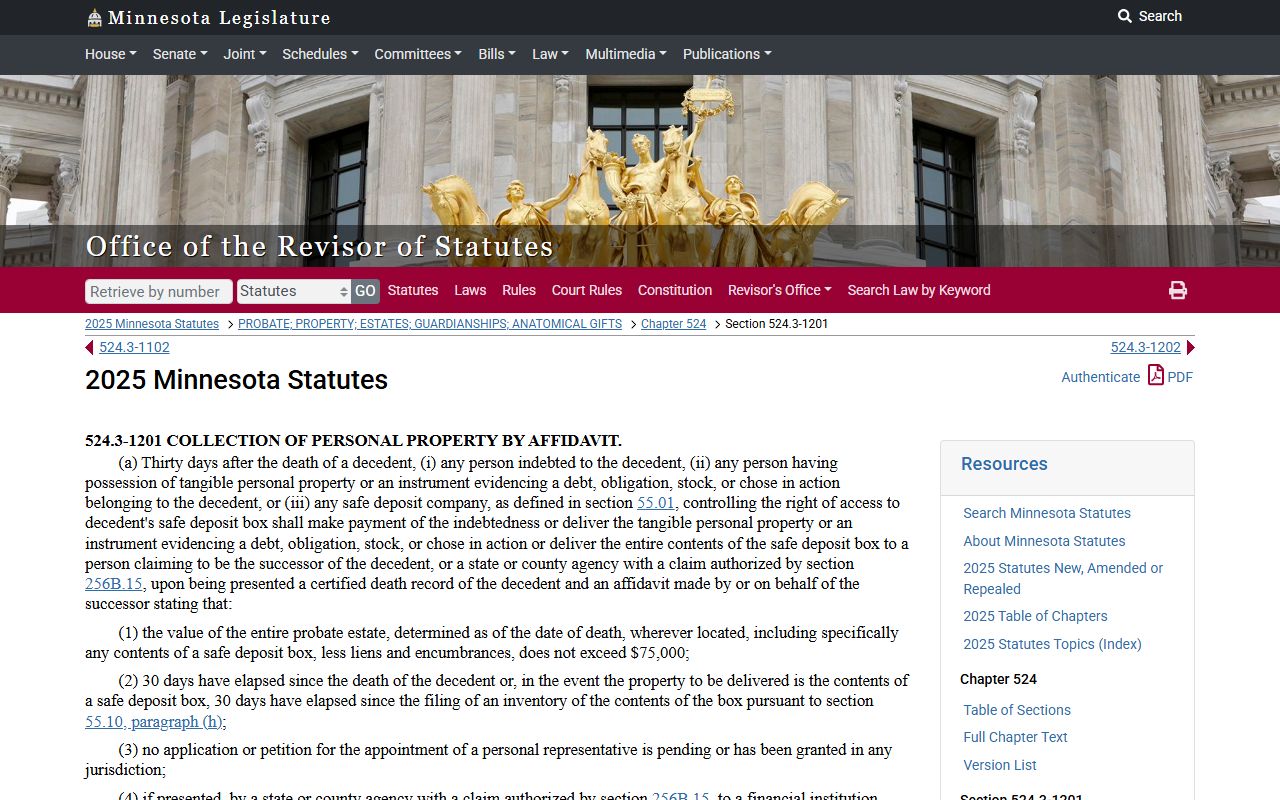
The small-estate statute is the basis for the affidavit form and the simplified collection process. Use it where it fits; for estates with real estate or disputed claims, full probate is the right path.
Personal Representative Duties in Dakota County
The personal representative's duties are described in the Minnesota Judicial Branch probate overview. The representative collects, inventories, and appraises the decedent's assets. The representative protects estate assets, gives required notices, handles creditor claims, pays expenses, debts, and taxes, and distributes the remaining assets to the proper parties. Closing forms may include the Inventory, Final Account and Proposal for Distribution, and Unsupervised Personal Representative's Statement to Close Estate.
- Determine whether probate is needed or whether a small-estate affidavit or nonprobate transfer applies.
- Select informal or formal probate based on complexity, disputes, will issues, and the need for a hearing.
- File the application or petition in Dakota County District Court if venue is proper.
- Receive court appointment as personal representative through order or letters.
- Identify heirs and devisees, inventory assets, give required notices, handle creditor claims, pay expenses/debts/taxes, and distribute property.
- File closing forms such as inventory, final account, and statement to close as required.
Dakota County Probate Glossary
Probate uses specific legal terms that can be hard to parse outside of the courtroom. The list below covers the terms most often seen in a Dakota County probate file.
- Testator
- A person who makes a valid will.
- Executor
- A personal representative named in a will to administer the estate.
- Personal Representative
- The court-appointed administrator of an estate, whether under a will or by intestacy.
- Intestate
- Dying without a valid will; Minnesota intestate law decides who inherits.
- Heir
- A person entitled to a decedent's property under intestate succession.
- Devisee
- A person named in a will to receive specific property.
- Guardian
- A person appointed to make personal decisions for a protected person.
- Conservator
- A person appointed to manage finances or property for a protected person.
Restricted Probate-Related Records in Dakota County
Probate at the Judicial Center includes Mental Health and Adoptions, but access to those records is more restricted than ordinary probate estate records. Adoption records are confidential under Minn. Stat. 259.61. Civil commitment and mental health records have their own access rules; MCRO states that public documents in civil commitment case types are not available through MCRO. The Probate Division phone is the local contact for procedural questions, but public release of restricted records will require either a statutory basis or a court order.
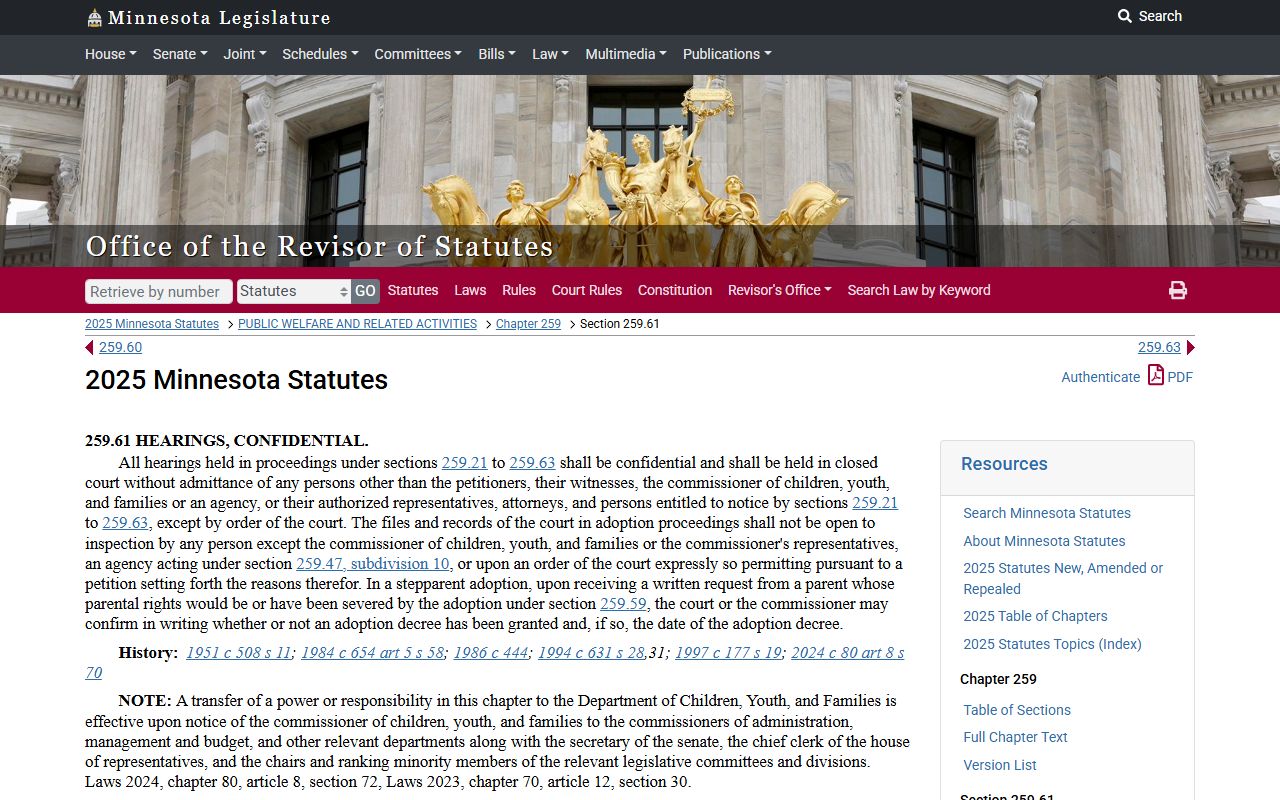
The adoption records confidentiality statute is the reason adoption matters are treated differently from estate probate, even though both are handled by the same Probate Division at the Judicial Center.