
How to Look Up Dakota County Jail Population Data
Dakota County does not publish a real-time jail population dashboard on its public pages. Operational data appears in the jail's jail fees page, the inmate search disclaimers, and county budget materials. State and national context comes from Bureau of Justice Statistics Jail Inmates reports, Vera Institute incarceration trends, and Prison Policy Initiative state pages. The Minnesota Department of Corrections also publishes jail inspection and population reports for facilities it inspects, which can be cross-checked with the county budget process.
For users who need an up-to-date Dakota County jail number, the fastest official path is Jail Information at 651-438-4800. The Sheriff's Office can also be reached at 651-438-4700 for press, public, or research inquiries. For raw context, BJS Jail Inmates reports list aggregate jail population, admissions, and average daily population at state and national level, with breakdowns by sex, race, and offense category.
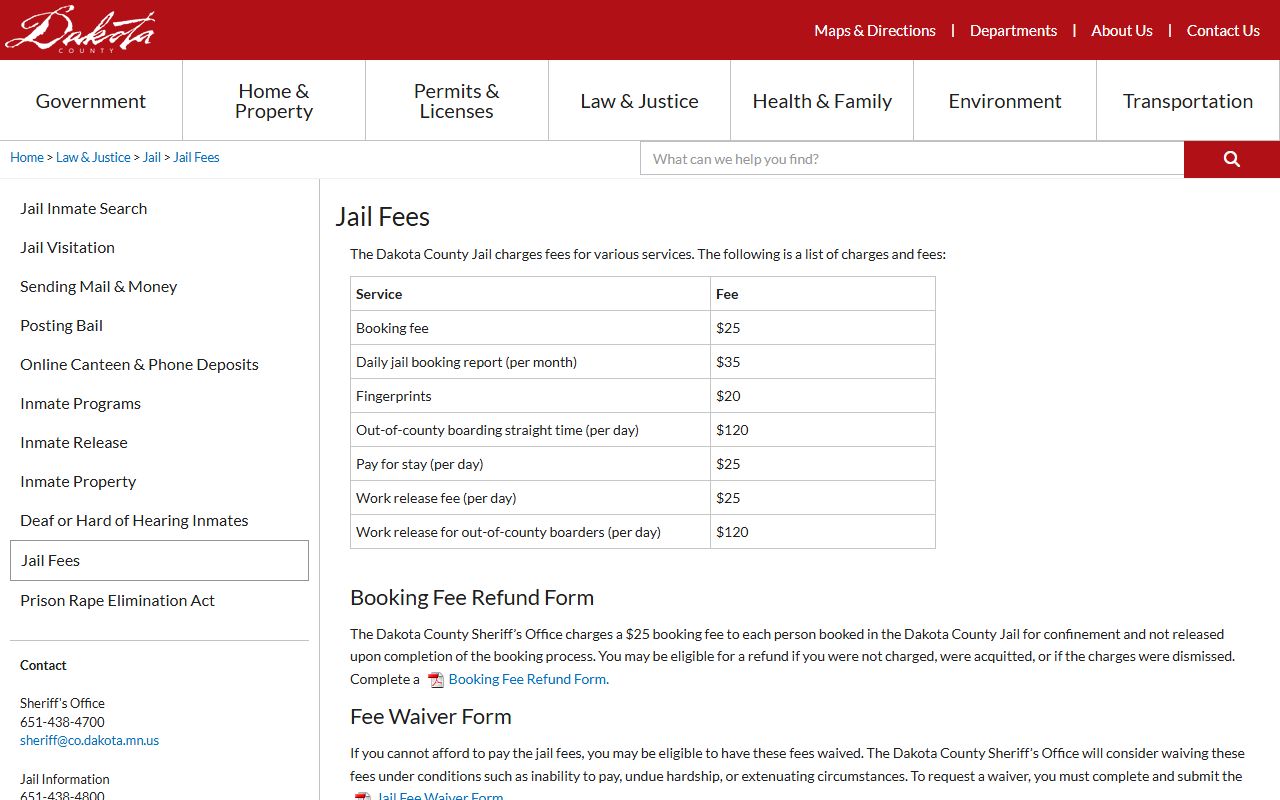
The Dakota County jail fees page sits in the Law & Justice section. It is the most consistent county source for operational rates, including out-of-county boarding and pay-for-stay.
Dakota County Jail Capacity Overview
The Dakota County Jail is part of the Law Enforcement Center at 1580 Highway 55 in Hastings. The official county pages confirm the address and Jail Information line, but they do not publish a current capacity number on the public-facing pages. Capacity for a county jail comes from the Minnesota DOC's jail inspection rating; readers needing a confirmed number should contact the Sheriff's Office or the Minnesota DOC for the most recent inspection rating.
| Facility | Address | Public phone | Notes |
|---|---|---|---|
| Dakota County Jail / Law Enforcement Center | 1580 Highway 55, Hastings, MN 55033 | 651-438-4800 | Current-custody search; visitation, mail, deposits, kiosk, property. |
Note: Current Dakota County jail capacity, average daily population, and demographic breakdown were not in the official public-facing pages reviewed; for a confirmed figure, contact the Sheriff's Office at 651-438-4700 or the Minnesota DOC inspections unit.
Average Daily Population
Average daily population, or ADP, is the daily count of inmates averaged across a reporting period. ADP smooths out single-day spikes and is a better indicator of jail use than any one snapshot. For Minnesota counties, ADP appears in annual jail inspection summaries from the state DOC and in some county budget books. For Dakota County specifically, the official online pages do not publish a recent ADP figure; the Sheriff's Office is the right contact for the current number.
Nationally, BJS reports that local jails admit several million people per year while holding a daily population in the hundreds of thousands. The mismatch between admissions and ADP is a reminder that most jail stays are short. In Dakota County, most public-facing custody activity moves through the Hastings facility; the inmate release page notes most releases happen at about 5 a.m. unless a court order specifies a different time.
Demographic Breakdown
BJS and Vera Institute publish breakdowns of jail populations by sex, race or ethnicity, and offense type at the national, state, and county levels. The official Dakota County pages reviewed for this project did not publish a recent jail demographic breakdown, so readers who need that data should request it from the Sheriff's Office or look at BJS Jail Inmates publications and Vera's county-level data work. Demographic context is essential for understanding pretrial detention disparities, which Vera and Prison Policy Initiative discuss in detail.
The Bureau of Justice Statistics publishes the Jail Inmates series and related annual reports. Use it for state-level and national context when reading any Dakota County number.
Pretrial vs Sentenced Population
A jail population is usually split between people held pretrial and people serving a misdemeanor or gross misdemeanor sentence. The pretrial portion is driven by charging decisions, bail amounts, and bond practices; the Dakota County bail and bonds page explains how bail and bond payment work and how warrants are deactivated upon eligible payment. The sentenced portion is driven by conviction rates, sentence lengths, and the available alternatives such as work release and pay-for-stay programs listed in the county jail fee schedule.
Vera and Prison Policy Initiative both highlight pretrial detention as the largest share of most county jail populations. Dakota County's Order Regarding Cash Bail, effective February 1, 2023, is one of the county-specific operational rules that affects bail decisions and indirectly the pretrial portion of the jail count.
Misdemeanor vs Felony Population
County jails generally hold a mix of misdemeanor sentenced inmates, gross misdemeanor inmates, pretrial defendants on felony charges, and inmates held on warrant or contempt holds. People with longer felony sentences typically move to a Minnesota DOC facility after sentencing rather than serving the time at the county jail. For Dakota County, the practical implication is that the long-term population skews toward shorter county-jail sentences and pretrial holds, with felony-sentenced individuals appearing in the Minnesota DOC offender locator after transfer.
Mental Health and Medical Population
Mental health and medical data inside a jail population is not public under Minnesota corrections-data rules. Minn. Stat. 13.85 classifies medical, mental health, classification, security, visitor, and internal correctional data as private. That is why a Dakota County jail roster shows custody information but not health flags, suicide-watch status, housing-unit security details, or grievance history. Aggregate data on mental health needs in jail populations is published at the state and national level by BJS and the Vera Institute.
National and State Context
For state and national jail context, BJS, Vera Institute, and Prison Policy Initiative are the standard sources. BJS publishes annual jail inmates data with admissions, releases, and population breakdowns. Vera publishes county-level incarceration trend tools. Prison Policy Initiative publishes a Minnesota state page and policy notes on pretrial detention, fees, and conditions. Pair any Dakota County figure with these sources to give the reader a sense of where the county sits.
Prison Policy Initiative publishes state-level pages with population and policy detail. Its Minnesota page is a useful starting point for the state context that helps a reader interpret county-level numbers.
Population Trends Over Time
A full Dakota County five-year jail population table was not located in the official online sources reviewed for this project. State and national jail populations have shifted over the past decade in response to bail-reform, treatment-court expansion, and changes in pretrial release practice. The Minnesota Judicial Branch and DOC publish higher-level statewide statistics that can be paired with county budget data. For Dakota County specifically, the county's treatment-court lineup, the Order Regarding Cash Bail, and the work-release fee structure are local levers that have shaped the population over recent years.
Searching for Dakota County Inmate Records by Name
This page is about Dakota County jail population data, not about searching for a specific person. For an individual-inmate lookup, the right tool is the Dakota County inmate records page, which links the official county jail inmate search and walks through the field set. People sentenced to Minnesota state prison appear in the Minnesota DOC offender locator after sentencing, and people in federal custody appear in the BOP locator.
Where the Dakota County Jail Data Comes From
Operational jail data in Dakota County comes from the Sheriff's Office and Jail Information. State inspections come from Minnesota DOC. Public-facing data is shaped by Minn. Stat. 13.82 (law enforcement data) and Minn. Stat. 13.85 (corrections data). Context comes from BJS, Vera Institute, and Prison Policy Initiative. Always separate Dakota County numbers from state and national numbers when publishing or quoting figures, and use the most recent reporting period each source supports.
Dakota County Jail Fee Policy and Population Impact
Dakota County's jail fee schedule shapes how the jail is used, and by extension how the population is composed. The county sets a $25 booking fee, a $35 monthly subscription to the daily jail booking report, a $20 fingerprint fee, $120 per day for out-of-county boarding, $25 per day for pay-for-stay, and $25 per day for work-release. Out-of-county work-release boarders are charged $120 per day. These fees do not change the count by themselves, but the booking-fee refund and jail-fee waiver options published on the county jail-fees page can affect who pays and who is documented as eligible for waiver.
Population data should be paired with fee and policy context. The Sheriff's Office uses correctional deputies for direct supervision of the inmate population, according to the recruitment page. Operational changes, such as a shift in pretrial release practice or a new specialty-court referral pathway, can move the population without changing capacity. Treatment courts in Dakota County include Adult Drug Court, DWI Court, Family Dependency Treatment Court, Juvenile Drug Court, and the Dakota/Carver Veterans Court.